First Time in Morocco: Practical Travel Guide to Transport, Money & Culture
Planning a first trip to Morocco involves practical decisions about transport, cash, connectivity, accommodation and local customs. This guide offers a starting point and links to official sources for details that can change.
Use this guide as a planning checklist. Fares, schedules, opening hours, entry rules and provider terms can change; verify time-sensitive details with the linked official sources and service providers before you travel.
 Jack BrelFounder & Editorial Director
Morocco at a Glance: Essential Practical Data
Critical reference points and legal requirements you need on hand from the moment you land.
Official Currency
Moroccan Dirham (MAD)
The Moroccan dirham (MAD) is the local currency. Exchange and cash-withdrawal options vary; check current currency rules and your bank fees before departure, and use licensed providers.
See Currency & ATM Rules →Languages Spoken
Darija • Amazigh • French
Morocco uses Moroccan Arabic (Darija) and Amazigh languages in daily life; French is common in many services, and English is spoken in some tourist settings. Language availability varies by region and provider.
Power & Outlets
Types C & E (220V, 50Hz)
European standard round two-pin sockets. US/UK travelers require a plug adapter; dual-voltage electronics operate natively.
Tipping Standard (Bakshish)
No fixed percentage
Tipping is discretionary and expectations vary by venue and service. Keep small notes if you choose to tip; ask your accommodation or guide about local practice.
Mosque Entry Policy
Access depends on the mosque and its visitor policy
Many mosques are not open to non-Muslim visitors. The Hassan II Mosque in Casablanca offers paid guided visits; check its current schedule, prices and visitor rules on the official mosque website before going.
Explore Cultural Tours →1. Itinerary Architecture: Geographic Realities & Road Timing
The biggest mistake first-time visitors make is underestimating travel times across mountain terrain and confusing rocky desert plateaus with sweeping Saharan sand dunes.
The High Atlas Speed Illusion (N9 Pass)
The drive between Marrakech and Ouarzazate via the Tizi n’Tichka pass (N9 highway) crosses mountain roads and can take several hours. Actual travel time depends on traffic, weather, road conditions and stops; check a current route planner and local updates before departure.
Planning tip: Build in a generous time buffer after a mountain crossing. Avoid connecting the drive to a flight or other time-critical booking unless you have allowed for delays.
The Desert Myth: Agafay vs. Merzouga (Erg Chebbi)
Tour operators routinely market “desert overnight trips” from Marrakech without explaining the dramatic contrast between stone plateaus and genuine sand dunes:
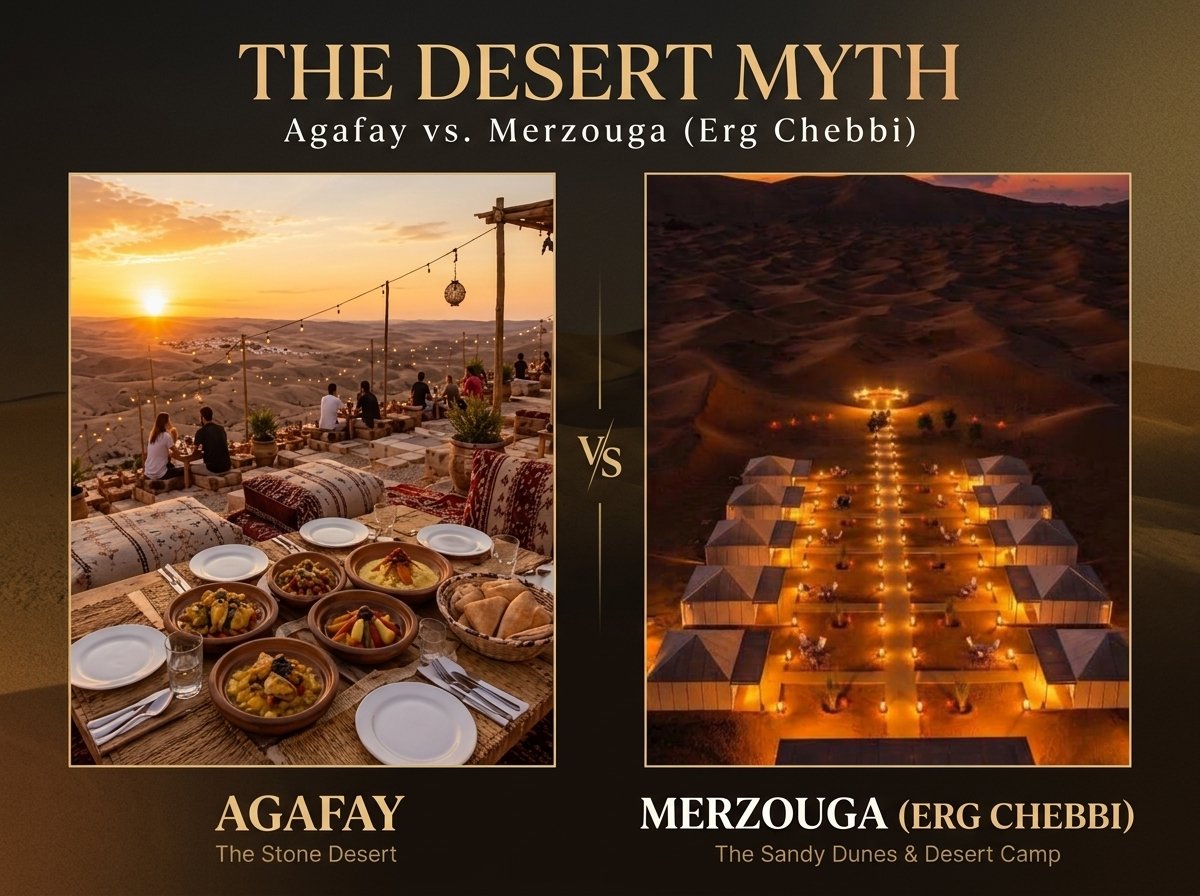
Agafay Desert
Rocky Stone Plateau (Reg)- Transit: Around 45 minutes from central Marrakech in typical conditions; allow for traffic and confirm the route before booking.
- Terrain: Arid, undulating limestone and stone hills. Zero sand dunes.
- Best For: Luxury glamping domes, sunset dinners, quad biking, and tight 48-hour city breaks.
- Time Required: Half-day excursion or a 1-night overnight stay.
Erg Chebbi / Merzouga
Expansive Dune Field (Erg)- Transit: A long drive from Marrakech that can take most of a day; check current routing and consider an overnight stop.
- Terrain: Towering golden dunes reaching up to 150 meters in height.
- Best For: Authentic Saharan expeditions, camel trekking, and deep astronomical stargazing.
- Time Required: Minimum 3-day / 2-night loop with a vital stopover in Dades Valley or Skoura.
2. Landing Protocol: eSIM vs. Local Physical SIM Cards
Navigating ancient Medinas requires constant GPS mapping. Relying solely on public Wi-Fi or expensive home roaming is a recipe for getting lost.
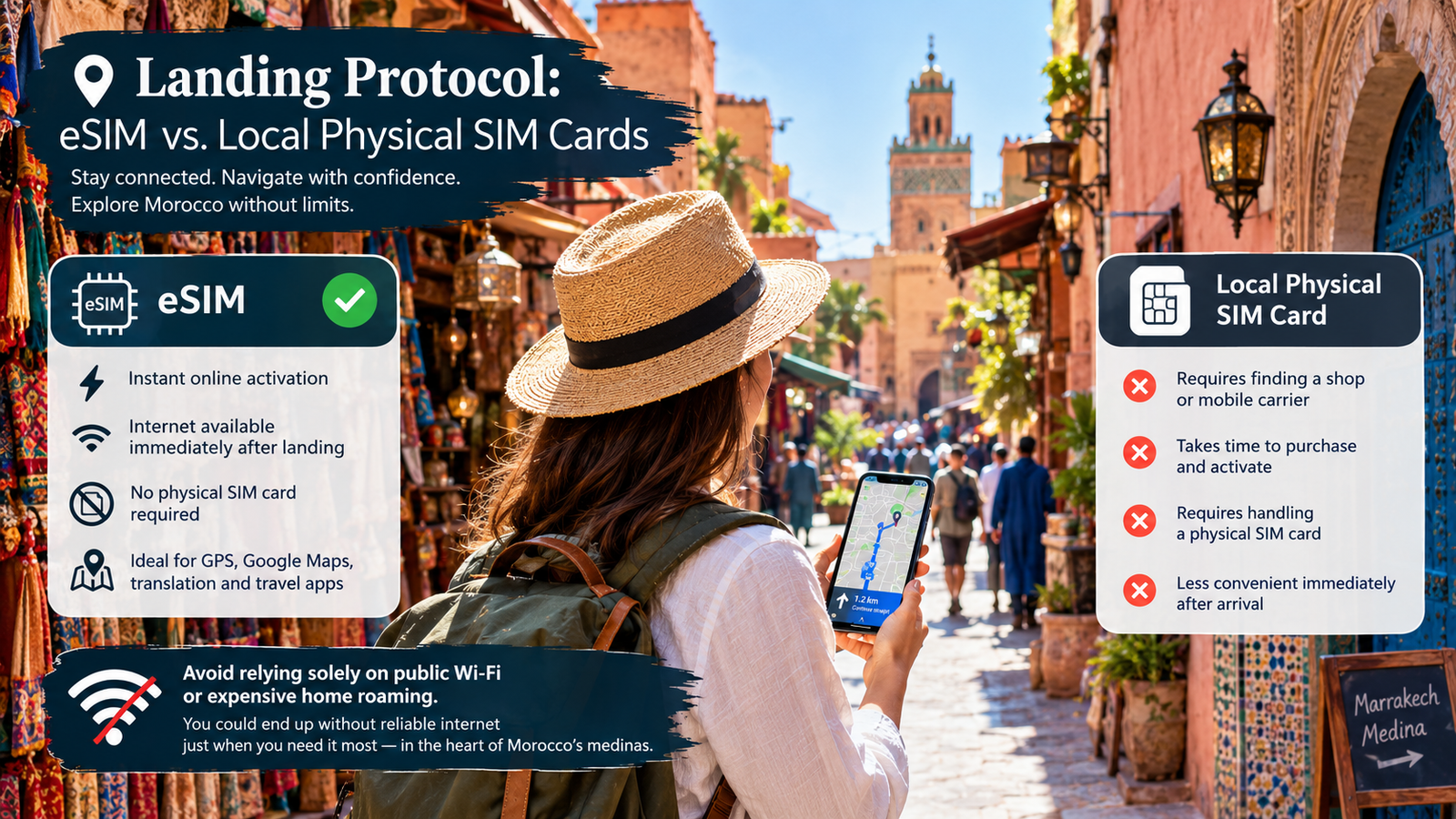
eSIM (Best for Frictionless Arrival)
A compatible travel eSIM can be installed before departure. Check your device compatibility, activation instructions, coverage map and provider terms; service may depend on setup and local network availability.
- Setup before travel: An eSIM may let you complete installation before arrival, though you may still need internet access or provider verification.
- Connectivity on arrival: Confirm when the plan activates and whether it includes data in your arrival area before relying on it.
- Dual-SIM option: If your phone supports dual SIM and your home plan allows it, you may be able to keep that line active for calls or verification messages. Check roaming charges with your home carrier.
Local Physical SIM (Best for Long Stays & Remote Areas)
SIM availability, registration requirements, prices and data allowances vary by provider and location. Compare current terms and coverage for your itinerary before choosing a local SIM.
- Coverage: Review each operator’s current coverage map for the specific cities and rural routes on your itinerary. Coverage can vary by location and device.
- Compare providers: Compare network coverage, data allowance, validity period, activation and registration terms before purchasing.
- Registration: Ask the provider what identification is required and whether registration or activation must be completed in person.
3. Managing Cash and Understanding ATM Currency Conversion
Morocco runs heavily on cash. While luxury hotels and fine dining accept international Credit Cards, small shops, markets, taxis, and tipping require local Dirhams (MAD).
Dynamic Currency Conversion: Check the Rate
Some ATMs offer to convert the withdrawal into your home currency. Read the displayed rate, fees and currency choice before confirming.
How would you like your transaction to be billed to your account?
Handling Cash and Small Change
Some cash machines may dispense larger notes. Keep smaller denominations when practical, as individual shops and drivers may have limited change.
Tactical Ground Workaround:
If you need change, use an ordinary purchase at a staffed shop or ask your accommodation where to exchange money safely. Avoid exchanging cash with unlicensed street sellers.
4. Moving Across Morocco: Trains, Taxis, and Self-Drive Tactics
Compare transport options and check current schedules, ticketing details and fares before your trip. At airports and stations, confirm the fare and destination with your chosen transport provider before setting off.
The ONCF Train Website Credit Card Rejection
ONCF sells tickets online and at stations. If an online card payment fails, check with your card issuer and use the official ONCF site or station ticket office to review available alternatives. Payment acceptance depends on the card and transaction; the cause of a decline cannot be determined from the page alone.
Station Touchscreen Kiosks
ONCF lists online, station-counter and ticket-machine purchase options. Availability and payment methods can vary by station; check the official ONCF passenger information or ask station staff.
Ticket Counter Pre-Booking
For Al Boraq and other trains, check the official timetable and seat availability for your travel date. Reserve ahead when your schedule is fixed, especially around busy travel periods; adjacent seats are not guaranteed.
Planning an Airport Taxi: What to Confirm
Airport taxi fares and arrangements vary by city and can change. Use the official taxi rank or airport information desk, ask for the current fare before departure, and confirm whether the trip is metered or a fixed price.
| Airport | Where to check | Before departure |
|---|---|---|
| Marrakech Menara (RAK) | Official airport taxi rank or information desk | Confirm the current fare, whether it is metered or fixed, and any extra charges. |
| Casablanca Mohammed V (CMN) | Official airport taxi rank or information desk | Confirm the current fare, whether it is metered or fixed, and any extra charges. |
Before you ride: In city taxis, ask whether the ride should be metered (« Khdem le compteur, s’il vous plaît »). At airports where a fixed fare is posted, confirm the current amount and any extra charges before the journey begins.
Heading to the Atlantic Coast or Atlas Mountains?
Compare rental options and read the supplier deposit, excess, insurance and cancellation terms before booking. Cover and prices vary by supplier and dates.
5. Accommodation Dynamics: Riads vs. Dars & Medina Arrival
Selecting authentic Moroccan lodging requires decoding local architectural vocabulary and preparing for the unique physical reality of pedestrian-only ancient city quarters.
Understanding Moroccan Architecture
Riad (The Garden Palace)
A traditional grand urban mansion built around a central open-air interior garden courtyard featuring citrus trees, palms, and central fountain basins. Designed to provide privacy, quiet, and passive cooling.
Dar (The Courtyard House)
A smaller traditional family townhouse centered around a paved, tiled interior patio (often with a small plunge pool or wall fountain, but without an inward-facing garden). Intimate and peaceful.
Kasbah (The Fortified Stronghold)
A massive fortified rammed-earth citadel or castle with watchtowers and thick perimeter walls, characteristic of the High Atlas, Dades Valley, and Saharan caravan trade corridors.
Medina Arrival Logistics & Luggage Porters (Koussa)
Many historic medina streets are pedestrian-only or too narrow for vehicles. Confirm the closest practical drop-off point and walking route with your accommodation or transfer provider before arrival.
How to Handle Handcart Porters (Koussa):
- The Hand-Off: Local porters with heavy two-wheeled wooden handcarts (koussa) will immediately approach offering to transport your rolling luggage directly to your Riad entrance.
- Agree before hiring: Ask the porter for the total price and confirm it before handing over your bags. Charges vary by location and distance.
- Price: There is no single rate for every route. Agree on the total charge in advance and clarify whether it is per bag or per group.
6. Cultural Etiquette: Dress Codes & Solo Female Travel Safety
Navigating Morocco with ease comes down to understanding local context: balancing cultural respect in conservative quarters with modern expectations in international hubs.
What to Wear: Respecting Local Norms
Morocco is a conservative yet exceptionally hospitable nation. Attire expectations vary significantly depending on where your feet are planted:
Conservative Demeanor Recommended
Both men and women should cover shoulders, chest, and knees. Revealing tank tops or short shorts draw persistent stares and communicate cultural detachment.
Relaxed International Standards
Dress expectations vary by venue. Swimwear is generally intended for pools and beaches; check the property’s guidance and consider covering up when moving through public streets.
Solo Female Travel Realities
Experiences vary by person and location. Some visitors report unwanted attention in busy tourist areas. Plan routes ahead, use well-lit streets when practical, and seek help from your accommodation or local authorities if you feel unsafe. Read current official travel advice before your trip.
Use simple ways to set boundaries
You do not need to engage with unsolicited approaches. A brief, clear ‘La, shukran’ (‘No, thank you’) and continuing on your way may help end an interaction. Use whatever response feels comfortable and safe.
Choose well-lit, busier routes when practical
If you need to check a map, step aside somewhere you feel comfortable, such as a shop or café, and use your saved route. Choose well-lit, busier streets when practical.
Identify a staffed place to ask for help
If an individual persists or makes you uncomfortable, turn immediately into any functioning boutique, pharmacy, or family-run riad. Announce the nuisance calmly; Moroccan shopkeepers will quickly intervene on your behalf.
7. Medina Defense: Haggling Tactics & Common Scams
Navigating historic souks is an exhilarating cultural experience once you recognize tourist-targeting street scripts and treat bargaining as a friendly ritual rather than a battle.
Common Tourist Scams and How to Respond
In busy visitor areas, you may encounter unsolicited offers of directions, services or goods. If you are unsure, pause, check an official sign or map, and confirm with your accommodation or a licensed provider.
“This Street is Closed”
If someone tells you a route is closed, verify it using posted signs, your map or another reliable source before changing plans. Do not follow an unfamiliar person to a different location unless you choose to.
Forced Henna Applications
At crowded squares or market areas, you may encounter unsolicited offers for henna or other services. Clearly decline if you are not interested, and agree on the service and price before accepting any paid service.
The Unsolicited Medina Guide
Someone may offer unsolicited directions or a tour. If you want a guided visit, agree on the route, duration, credentials and price in advance with a provider you have chosen. You can decline unsolicited offers.
How to Haggle: The Baraka Negotiation Framework
Souk shopping is an ancient social exchange grounded in mutual respect (baraka), tea sharing, and cordial banter. It is not an adversarial zero-sum confrontation.
- 1
Start with a respectful offer you are comfortable paying
If bargaining is customary and you wish to take part, make a respectful offer within a budget you are comfortable with. Prices and customs vary by product, shop and location; you can also decline politely.
- 2
Agree a price before the service or purchase
Trade concessions in incremental steps. A fair, win-win transaction for high-craft items (leather bags, babouches, brass lanterns, ceramics) typically settles at 60% to 70% of the original retail ask.
- 3
The Polite Walkaway Maneuver
If the price remains beyond your budget, thank the vendor graciously and walk slowly toward the alleyway. If their true margin allows it, they will invariably call you back to accept your last counter-offer.
8. Health, Dining & Technical Packing Checklist
Protecting your digestion and packing the correct tactical footwear prevents 95% of common traveler fatigue across Morocco’s historic cobblestone quarters.
Food & Tap Water Protocol
Do not drink unboiled tap water in Morocco. While municipal water in Casablanca and Marrakech is treated, unfamiliar mineral balances and older urban pipe systems frequently trigger bacterial stomach upsets in visitors.
- Drinking water: If you are unsure about local water quality or have a sensitive stomach, choose sealed bottled water or water treated according to current public-health guidance. Check that the seal is intact.
- Alternative Solution: Carry an insulated self-sterilizing UV-C purification bottle or multi-stage filtration flask to minimize plastic waste.
- Food hygiene: Choose food that is freshly prepared and served hot, and use your judgment about the cleanliness and turnover of a stall. These steps can reduce some risks but cannot guarantee that food is safe.
Traditional Hammam Etiquette
Visiting a local public bathhouse (hammam) is an essential Moroccan hygiene and community ritual. First-time bathers should understand the physical progression:
- Savon Noir Application: Your skin is lathered in traditional black eucalyptus olive soap and softened in warm steam chambers.
- The Kessa Exfoliation: An attendant (tiyaba or kessal) uses a coarse textured crepe glove (kessa) to rigorously scrub away dead skin layers.
- Warm Bucket Rinses: Multiple buckets of fresh warm water are poured over you to finish the cleanse.
Technical Packing Essentials
Check off these four mission-critical items before closing your suitcase for Morocco:
Official Sources to Check Before Your Trip
Travel rules, safety notices, transport schedules, fares and opening hours can change. Use these primary sources for the latest details, and confirm provider terms before making a booking.
- UK Foreign, Commonwealth & Development Office: Morocco safety, laws and local customs
- U.S. Department of State: Morocco travel advisory and emergency contacts
- France Diplomatie: Morocco travel advice and useful contacts
- ONCF: official passenger information · Timetables and ticket booking
- Hassan II Mosque Foundation: guided visit hours, prices and rules
- Visa: paying in local currency when offered a currency conversion choice
- U.S. CDC: Morocco traveler health advice
Frequently Asked Questions (FAQ)
Answers to common trip-planning questions, with links to official sources where available. Check current local guidance before you travel.
Is Morocco safe for first-time travelers?
Morocco is a popular destination, but no trip is risk-free. Safety conditions vary by place and time. Petty theft and scams can occur in busy tourist areas, and official travel advice also notes occasional violent crime. Keep valuables secure, stay aware of your surroundings and review current UK government travel advice before departure.
Can unmarried couples share a hotel room or Riad?
Accommodation policies and laws can depend on the people involved and the property. UK government travel advice says the law on unmarried couples sharing a hotel room does not generally apply to visiting foreign nationals, particularly in popular tourist areas. Ask your accommodation about its policy; if one partner is a Moroccan national or you are unsure, consult current official advice. This is not legal advice.
Can I travel to Morocco during Ramadan?
Yes, visitors can travel during Ramadan, but dates, opening hours and service availability vary by year, location and business. Check transport and attraction schedules directly, follow local guidance, and be considerate of people who are fasting.
Remove All Logistics Stress: Connect with Our Local Travel Team
Use the contact page to send a question about routes, train planning or arrival logistics. Response times vary with team availability.
Travel-planning enquiries
Response times vary with team availability and local operating hours.
Transparent partner links
If a service is available, confirm its provider, terms and price before booking. We disclose affiliate relationships where they apply.
Check availability, service details and pricing directly with the team before making plans. Review our Terms of Service and Privacy Policy.