TRAVEL ESSENTIALS FOR Morocco?
Preparing for North Africa requires smart logistics. From avoiding dynamic currency conversion at ATMs and choosing the right connectivity to understanding medical safety and private clinic protocols, here are practical points to help you prepare for your trip.

Top Morocco Travel Essentials Before Landing
Emergency Medical Preparedness: Insurance Guarantees & Private Clinics
Healthcare access and payment procedures vary by facility and location. Some hospitals may request upfront payment or proof of insurance. Review your policy and keep your insurer assistance details accessible. The CDC travel health guidance for Morocco recommends planning how to access care and reviewing coverage.
STAY CONNECTED compare eSIM and local SIM options.
Mobile data can help with maps, messaging, and bookings after arrival. Coverage, activation time, and available services depend on your location, device, and provider.
Local SIM purchase & setup
Buying a physical SIM at the airport or in town may involve a queue, identity checks, and a SIM swap. The process and waiting time vary by seller and arrival conditions.
- Prices, available bundles, and sales practices vary; compare the current offer and its terms before buying.
- A seller or provider may ask for identity documents; confirm current registration requirements and activation steps.
- SMS and two-factor authentication delivery depend on your home carrier, roaming settings, and selected SIM.
Travel eSIM setup (subject to plan terms)
If your phone supports eSIM and is unlocked for other networks, you may be able to install a profile before travel. Follow the provider setup instructions; service start time, roaming settings, network access, and activation vary by plan and location.
- Available partner networks depend on the package; check current coverage and network details with the provider.
- You can usually keep using your existing messaging account if you retain its number and account; app and SIM settings matter.
- An eSIM avoids swapping a physical travel SIM, if your device supports eSIM and the required dual-SIM configuration.
| Feature / Parameter | Morocco Travel eSIM Recommended | Airport Local Physical SIM |
|---|---|---|
| Setup Timing | ✔ May be installed before departure if the provider allows it; follow its setup steps | ✕ In-line at baggage claim after landing |
| Arrival Latency | ✔ Activation time depends on provider, plan, settings, and local coverage | ✕ Purchase and activation time vary by seller, documents, and queue |
| WhatsApp & 2FA | ✔ Your home number may remain available; OTP delivery depends on your home carrier and settings | ✕ A local SIM may have a different number; confirm with the seller |
| Passport Paperwork | ✔ Some plans may be purchased digitally; identity checks may still apply | ✕ Identity requirements vary by operator and purchase channel |
| Dual-SIM Capability | ✔ Dual-SIM use depends on device capability and line settings | ✕ A physical local SIM may require using the SIM slot; device setup varies |
MONEY, ATMS & TIPPING the ground reality of cash in Morocco.
While contactless payments exist in upscale hotels and contemporary shopping malls, Morocco remains an economy where cash is king. Here is how to withdraw safely and tip with respect without getting overcharged.
Cash vs. Card Acceptance

Never step into a medina, taxi, souk stall, or roadside café assuming you can tap your Visa or Mastercard. Keep local currency on you at all times.
- Cash Mandatory: Petit taxis, street food stalls, souk artisans, public restrooms, and small riads for city tourist taxes.
- Card Accepted: Major supermarket chains (Carrefour, Marjane), luxury hotels, and tourist dining in modern districts (Gueliz, Hivernage).
- Pro-Tip: Break large 100 and 200 MAD banknotes in convenience stores or supermarkets; taxi drivers and small vendors rarely have change.
ATM Safety & Foreign Cards

Avoid standalone convenience-store ATMs in tourist squares that levy aggressive dynamic currency conversion (DCC) fees or swallow foreign cards.
- Trusted Official Banks: Stick strictly to ATMs attached to physical bank branches—specifically Attijariwafa bank, BMCE / Bank of Africa, and Banque Populaire.
- Currency conversion: If a terminal or ATM offers conversion into your home currency, review the displayed rate and fees. Paying in MAD generally lets your card issuer handle conversion; check your card provider fees. Visa explains dynamic currency conversion.
- Withdrawal limits: Limits and fees vary by ATM, bank, and card. Check the screen and your card provider before confirming.
The Tipping Rulebook (Baksheesh)
There is no single tipping rate for Morocco. Any tip is discretionary and can vary with the setting, the service provided, and whether a service charge is already included. These examples are flexible gestures, not set amounts:
Local Cafés & Mint Tea
At a café, you can round up the bill or leave some small change if you wish.
Sit-Down Restaurants
At a restaurant, check the bill for a service charge first. If none is listed, a tip for good service is your choice; no fixed percentage applies.
Riad Baggage Handlers
For a porter who carries your bags, consider a discretionary tip based on the number of bags and the help provided.
Private Drivers & Day Guides
For a private driver or guide, consider the length and quality of the service and your group size. Keep any tip separate from the agreed fare or guide fee.
GETTING AROUND trains, taxis, and scenic road networks.
From Africa’s fastest high-speed rail to navigating medina taxi ranks and mountain highway checkpoints, here is how to move around Morocco smoothly, safely, and without overpaying.
High-Speed & Intercity Trains

Morocco's passenger rail system operated by the ONCF is the cleanest, most reliable way to connect northern coastal hubs with imperial cities.
Petits Taxis vs. Grands Taxis
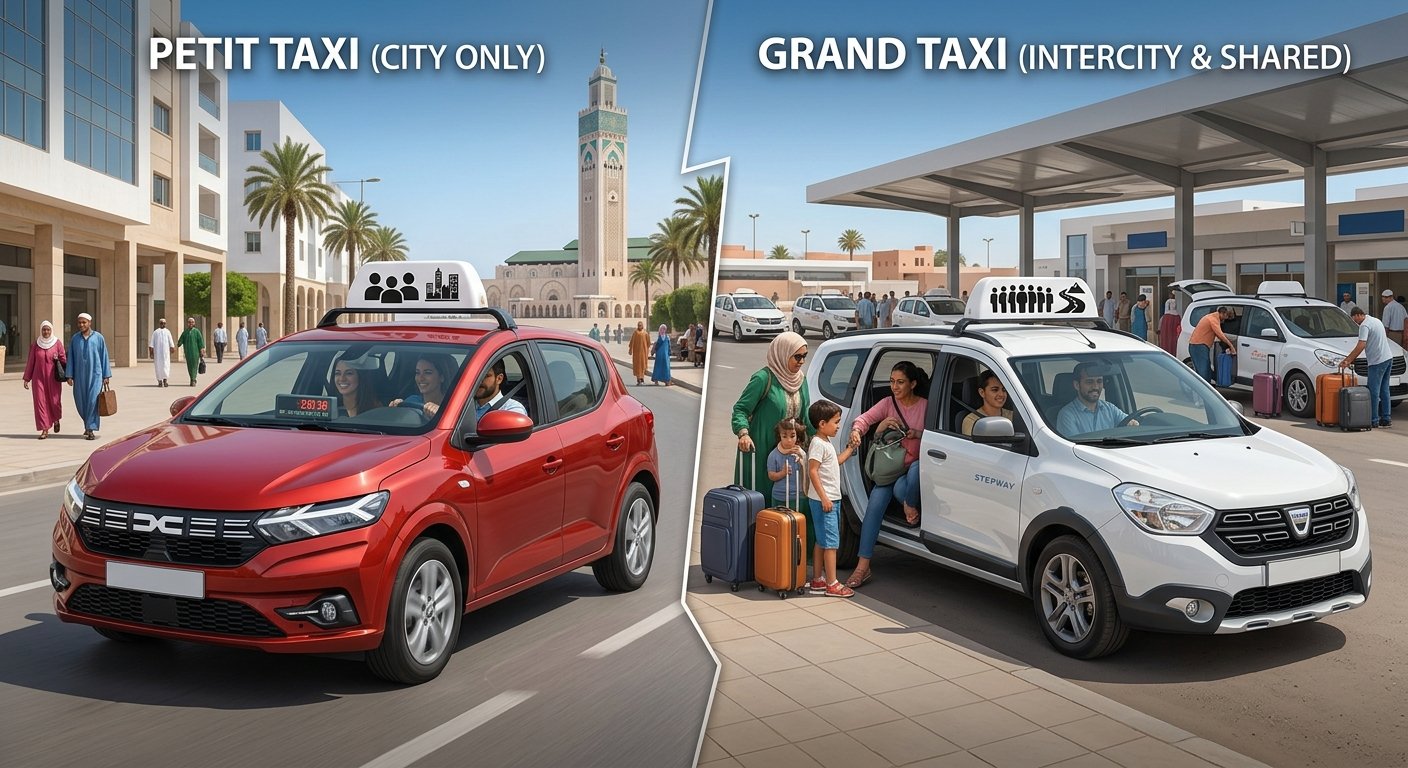
Two completely distinct taxi systems coexist in every city. Knowing which to hail prevents confusion and street negotiation disputes.
Car Rental & Road Safety

Renting a car unlocks the freedom of the High Atlas, southern valleys, and coastlines. Moroccan road infrastructure is modern, but warrants vigilance.
CULTURE, ETIQUETTE & SCAMS navigate with respect and street smarts.
Morocco is renowned for its generous hospitality, but respecting local cultural customs and recognizing common street hustles ensures a relaxed, hassle-free trip.
Strict Drone Ban: Do Not Pack a Drone
Bringing a recreational drone into Morocco without prior official commercial authorization from civil aviation authorities is strictly illegal. Luggage is systematically X-rayed upon arrival at all Moroccan airports and ferry ports. If detected, your drone will be immediately confiscated by customs, and you may face formal police interrogation and heavy fines. Leave drones at home.
01 Cultural Ground Rules
Dress Code & Respectful Attire
While beach resorts, hotel pools, and upscale modern city quarters welcome standard western holiday wear, traditional medinas, souks, and rural Berber villages call for modest clothing.
- Shoulders & Knees Covered: Lightweight linen shirts, long trousers, maxi dresses, or midi skirts keep you cool while showing cultural respect.
- Mosque Access: Non-Muslim visitors cannot enter working mosques throughout Morocco, with the single exception of the monumental Hassan II Mosque in Casablanca via guided ticketed tours.
Alcohol: Availability & Rules
Alcohol is legal and readily accessible across Morocco, but consumption is governed by clear social expectations.
- Where to Buy: Available in licensed tourist restaurants, rooftop cocktail lounges, international hotel bars, and dedicated annexes inside major hypermarkets (such as Carrefour Market).
- Public Spaces: Drinking alcohol on the street, medina plazas, or public beaches is strictly prohibited by law and culturally offensive. Keep consumption within licensed premises or your private riad terrace.
02 Classic Scams Decrypted
« That Street is Closed Today »
The Setup: As you wander through narrow labyrinthine alleys in Marrakech or Fès looking at your phone, a passerby or teenager casually remarks: "No way through, that road is closed for prayers" or "Mosque only, turn here!"
If someone says a medina street is closed and offers to guide you elsewhere, verify the route with your accommodation or an offline map. Situations vary; avoid following anyone unless you want their assistance.
Unofficial « Helpful » Faux Guides
The Setup: A friendly local approaches you near city gates or medina parking ranks, offering spontaneous directions, historic anecdotes, or escorting you to your riad for "free."
Agree on any guiding service and price before accepting it. To find a licensed guide, check with an official tourism office or your accommodation and verify current licensing requirements with Morocco tourism authorities.
Prepare for your trip
What to Pack for Morocco
Pack for changing temperatures, long walks and different settings. A few thoughtful choices make it easier to move between city medinas, the coast, mountain areas and the desert.
Light, adaptable layers
Choose breathable clothes for warm days, with a light layer for air-conditioned transport and cooler evenings. In traditional neighborhoods, covering shoulders and knees is a considerate option.
Comfortable walking gear
Bring supportive shoes with grip for uneven medina lanes, steps and day trips, plus a small secure day bag for water and daily essentials.
Sun, health & activity kit
Sun protection and any personal medication are useful every day. Add activity-specific items for a hammam visit, a desert night or a mountain walk.
Documents & technology
Keep travel documents accessible and protected. A phone charger, power bank and reliable mobile connection can simplify navigation and travel logistics.
FREQUENTLY ASKED QUESTIONS answers to real travel concerns.
Clear, practical answers addressing common legal, health, and cultural queries before you land in Morocco.
Is tap water safe to drink in Morocco?
Water safety can vary by location and activity. The CDC Morocco guidance advises travelers to make careful food and drink choices. If you are unsure about a particular source, choose sealed bottled water or water treated according to public health guidance.
For advice tailored to your health needs, consult a qualified clinician or travel-health service before departure. Water and sanitation conditions can vary; follow current local and public health guidance.
Do I need cash in Morocco, or are credit cards accepted everywhere?
Yes, cash (Moroccan Dirham – MAD) remains essential. Although contactless credit cards are widely accepted at luxury riads, rental car agencies, modern hypermarkets (Carrefour, Marjane), and upscale restaurants in modern districts (such as Gueliz or Hivernage), Morocco's daily street economy runs on cash.
Petit taxis, street food stalls, medina souk artisans, historical monument ticket booths, and luggage handlers accept cash only. Withdraw money from official bank-attached ATMs (Attijariwafa bank, BMCE, Banque Populaire) and break large 100/200 MAD banknotes early in convenience stores.
Can unmarried foreign couples stay in the same hotel room?
Yes, absolutely. Moroccan penal laws restricting unmarried cohabitation apply strictly to Moroccan citizens.
If both travelers hold foreign passports, hotels, riads, and registered guest properties will never ask for a marriage certificate or inquire about your relationship status. Foreign couples share private rooms, riad suites, and desert glamping tents without any issue. (Documentation is only requested if one partner holds Moroccan nationality).
What should women wear when visiting Morocco?
There is no legally enforced dress code for tourists, and non-Muslim travelers are never expected to wear headscarves or veils.
In traditional medinas, rural mountain villages, and crowded markets, dressing modestly—specifically covering shoulders and knees with loose, breathable fabrics (linen button-downs, midi/maxi dresses, light pants)—shows respect for local customs and significantly minimizes unwanted street attention. In beach towns (Taghazout, Essaouira) or around hotel resort pools, standard western swimwear and summer apparel are completely acceptable.
Sources & review
Last reviewed: 6 November 2026. Travel rules, transport schedules, network coverage, package availability, prices, and provider terms can change. Check official guidance and current package terms before travel or purchase.
- Apple: eSIM providers and device support and how to check whether an iPhone is unlocked. Android users should check device maker and carrier support pages.
- Morocco ANRT: 5G launch and coverage information. Actual signal and partner-network access vary by area and plan.
- ONCF Voyages for current train routes, timetables, seats, and fares.
- NARSA road-safety guidance for speed limits; posted signs and instructions on the road take precedence.
- U.S. Department of State Morocco travel information and CDC Morocco travel health guidance for healthcare and insurance considerations.
- Electrical Safety First: Morocco plug types and supply (Type C/E, 220 V, 50 Hz).
- Visa: dynamic currency conversion. Exchange rates, ATM limits, and fees depend on the card issuer and ATM; confirm with your bank and check the ATM screen.
For an eSIM, read the specific package terms for supported devices, partner networks, data allowance, validity, activation start, roaming, tethering, identity checks, and refunds.

THERE’S MORE TO Morocco.
Let curiosity lead. We’ll help with the rest.
Find your way ↗