7 Days in Morocco by Train: The Ultimate Imperial Rail Journey
Spending 7 days in Morocco by train offers a relaxed, culture-rich route linking the country’s historic imperial capitals via the national rail network (ONCF). Skip high-stress mountain driving and unreliable shared vans by traveling on a mix of services: Al Bidaoui from the airport, TNR between Casa-Port and Rabat-Ville, and Al Atlas intercity trains to Fès and Marrakech. This itinerary does not use Al Boraq; Al Boraq is a high-speed option on the separate Casa-Voyageurs–Rabat-Agdal corridor.
Field Logistics & Smart Rail Setup
Planning 7 days in Morocco by train frees you from car rentals and security deposits, but smooth transit across stations depends on three fundamental setup steps before arrival.
Prepaid eSIM Activation
Do not rely on crowded airport or station Wi-Fi to load mobile tickets. Install your data profile before departure for immediate 4G/5G connectivity upon landing at Mohammed V International Airport (CMN).
Check the Booking Window by Train
Booking windows vary by service and route. Check the ONCF Voyages planner for your journey date, availability, and current fares.
Luggage & Station Transit
Moroccan trains have overhead racks suitable for 40L travel packs or medium suitcases. Large oversized hard-cases must sit near carriage vestibules. Keep valuables, passports, and tech in a personal daypack at your seat.
Satellite Route Map: 7 Days in Morocco by Train
Select a day to view its satellite route, numbered stops, rail service, and directions link. The lines are approximate route corridors, not turn-by-turn tracks.
Day 1: airport shuttle and Casablanca arrival.
Day-by-Day Itinerary: 7 Days in Morocco by Train
The approximate durations below are based on the ONCF timetable references linked beside each rail leg. Timetable files were checked on 7 November 2026; verify your travel date and live fare in ONCF Voyages before booking.
Arrival at CMN Airport & The Atlantic Landmark

Land at Mohammed V International Airport. Pass through border control and head down to the lower level of Terminal 1 to board the direct ONCF airport shuttle. Arrive at Casa-Voyageurs or Casa-Port, check in, and spend the afternoon at the Hassan II Mosque—the only operational mosque in Morocco open to non-Muslim visitors through official guided tours.
Casablanca to Rabat: The Quiet Royal Capital
Board the TNR commuter service to Rabat-Ville, stepping out directly into the Art Deco heart of the administrative capital. Rabat is civilized, low-hassle, and exceptionally pedestrian-friendly. Spend midday exploring the whitewashed blue lanes of the Kasbah of the Udayas overlooking the Atlantic, followed by the Hassan Tower and Chellah.
Rabat to Fès: Journeying into the Medieval Heart
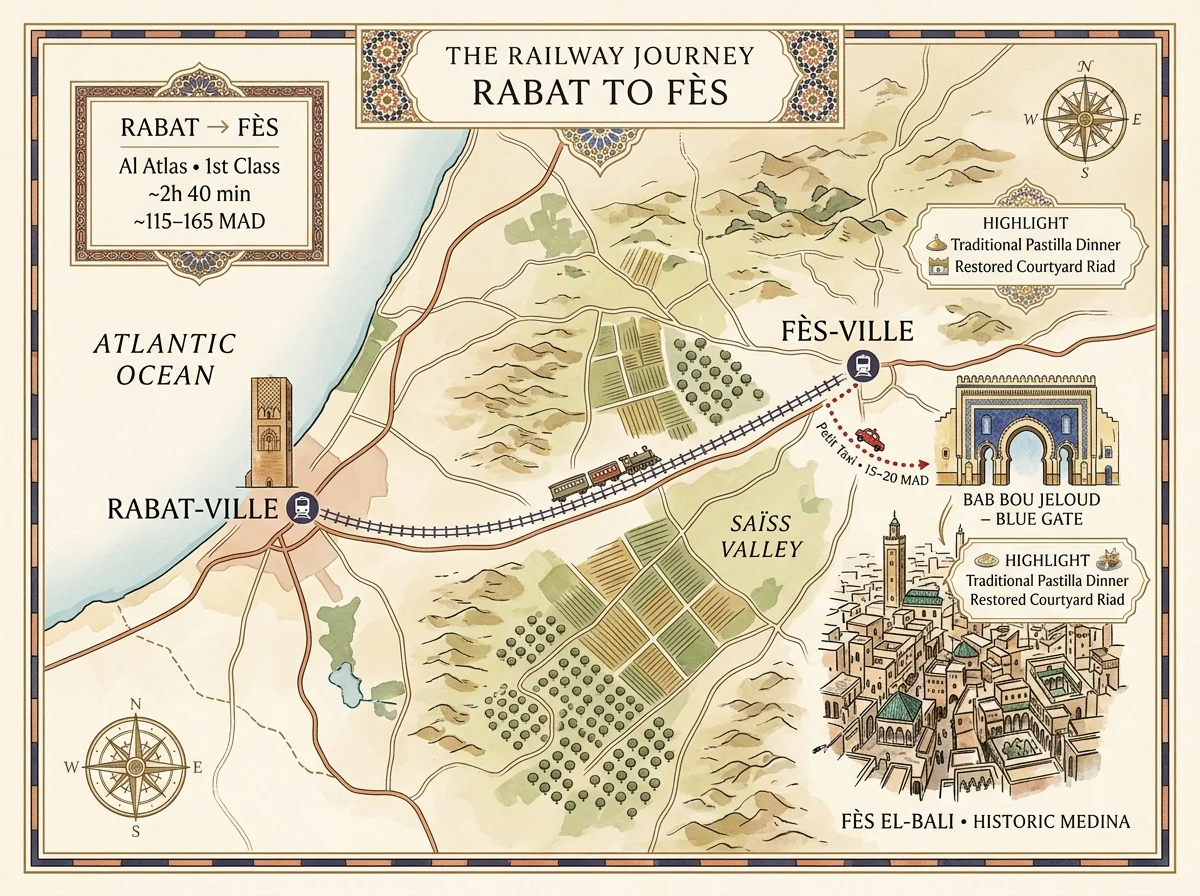
Watch coastal plains give way to rolling olive groves across the Saïss valley. Arriving at Fès-Ville station, take a red Petit Taxi to Bab Bou Jeloud (the Blue Gate); ask for the meter or agree the fare before setting off. Check into your riad inside Fès el-Bali and spend your first evening on a quiet terrace listening to the Maghrib call to prayer echo across 9,000 car-free alleyways.
Deep Medina Immersion: Tanneries & Sacred Madrassas
Dedicate a full day to unravelling Fès el-Bali. Visit the 14th-century Bou Inania Medersa, admire the carved cedarwork of Al-Attarine, and observe the centuries-old leather dyeing process at the Chouara Tannery from an overlooking terrace. Stop by artisan workshops where copper-beaters, weavers, and zellige tile-makers preserve ancient heritage trades.
Fès to Marrakech: The Great Trans-Moroccan Scenic Run
This is Morocco’s classic cross-country rail voyage. Settle into an air-conditioned 1st Class compartment. The Al Atlas train travels south via the Casablanca area and Benguerir toward the Haouz plain. Arrive at Marrakech’s modern terminal in Guéliz by late afternoon. Transfer to your riad and dive into the spectacle of Jemaa el-Fnaa.
Palaces, Botanical Escapes & Rooftop Living
Start early at the Bahia Palace to experience intricate stucco and painted wood ceilings before tour buses arrive. Explore the ruins of El Badi Palace and the Saadian Tombs in the Kasbah quarter. In the afternoon, take a quick taxi to Guéliz for the cobalt-blue Jardin Majorelle and the Yves Saint Laurent Museum. Conclude with a sunset rooftop mint tea overlooking the Koutoubia minaret.
Final Souk Exploration & Departure Logistics
Spend your final morning picking up spices, argan oil, and handcrafted souvenirs in Rahba Kedima square. If flying out of Marrakech (RAK), take a taxi to the airport and allow extra time for traffic. If departing from Casablanca (CMN), take an Al Atlas train to Casa-Voyageurs or Casa-Oasis, then connect to the Al Bidaoui airport shuttle. Check the complete connection and allow a generous buffer in the ONCF planner.
Budget Guide: How Much Does 7 Days in Morocco by Train Cost?
Fares vary by route, service, date, class, and availability. Use ONCF Voyages to check current prices before budgeting. Journey times are approximate and may change.
| Train Route Sector | Service Type | Duration | 2nd Class (MAD) | 1st Class (MAD) |
|---|---|---|---|---|
| CMN Airport → Casa-Voyageurs | Al Bidaoui Shuttle | About 47 min ONCF timetable | Check ONCF | Check ONCF |
| Casa-Port → Rabat-Ville | TNR commuter service | About 1 h 15 min ONCF TNR timetable | Check ONCF | Check ONCF |
| Rabat-Ville → Fès-Ville | Al Atlas intercity | About 3 h ONCF Al Atlas timetable | Check ONCF | Check ONCF |
| Fès-Ville → Gare de Marrakech | Al Atlas intercity | About 7 h ONCF Al Atlas timetable | Check ONCF | Check ONCF |
| Total for the listed route | Total varies by route, date and class — check current fares | |||
Station Survival: Managing Transfers & Petit Taxis
Exiting a Moroccan train station with luggage is the moment travelers face the most taxi hassle. Here is the operational protocol for each stop.
Casablanca: Casa-Voyageurs vs. Casa-Port
Casa-Voyageurs is the central hub for long-distance trains to Marrakech and the South. Casa-Port is downtown by the harbor and serves fast shuttles to Rabat. If arriving from CMN Airport, alight at Casa-Voyageurs. Take a red Petit Taxi and demand the meter (« Khdem el compteur, afak »). Fares to city hotels should not exceed 20–30 MAD.
Rabat-Ville: Central & Effortless
Do not alight at Rabat-Agdal unless instructed by your host. Rabat-Ville places you right on Avenue Mohammed V, only a 10-minute flat walk from the medina entrance. Rabat taxi drivers (blue Petit Taxis) are the most honest in Morocco and routinely turn on the meter without being asked. Typical fare within town: 10–15 MAD.
Gare de Fès: The Blue Gate Transition
Located in the Ville Nouvelle. Avoid the drivers waiting immediately inside the terminal doors quoting 100 MAD flat rates. Walk 30 meters out to the taxi rank on the main boulevard. Flag a red Petit Taxi to Bab Bou Jeloud. Insist on the meter; during daytime hours, this trip costs approximately 15–20 MAD.
Gare de Marrakech: The Ochre City Arrival
A striking terminal in Guéliz where yellow Petit Taxis wait outside. Marrakech drivers frequently refuse to turn on meters for arriving tourists. Agree on a fixed price before putting bags in the trunk: expect to pay 50–70 MAD for a direct ride to Jemaa el-Fnaa or Bab Doukkala. Alternatively, use the local ALSA bus #19 shuttle (30 MAD).
Frequently Asked Questions: 7 Days in Morocco by Train
Is 7 days in Morocco by train enough time to explore the country?
Yes, spending 7 days in Morocco by train is ideal if you focus on the central rail corridor linking Casablanca, Rabat, Fès, and Marrakech. Trying to reach the Sahara Desert or the High Atlas mountains within a single week requires 8 to 10 hours of road transit per day, which leads to burnout. Sticking to the train allows you to maximize cultural sightseeing while keeping travel days relaxed and predictable.
Can I purchase ONCF train tickets with a foreign credit card?
Yes. Payment methods can depend on the booking channel and card issuer. Check the current payment options on the official ONCF Voyages site; station ticket offices are another option.
Is train travel safe for solo female travelers in Morocco?
Yes, Moroccan trains are safe and comfortable for solo female travelers, particularly in 1st Class where conductors make frequent rounds and passenger turnover is lower. Standard precautions apply: dress modestly, sit close to families or couples in the carriage, and avoid late-night station arrivals.
Can I reverse this route (starting in Marrakech and ending in Casablanca)?
Absolutely. If your inbound flight lands at Marrakech Menara (RAK), you can run the exact route in reverse: Marrakech → Fès → Rabat → Casablanca (CMN). Schedules, fares, and availability can differ by date and direction; check both legs separately in ONCF Voyages.
Need Instant Route Verification on WhatsApp?
Planning your trip and have questions about train departures, riad locations, or holiday timetables? Reach out to our boots-on-the-ground Morocco Wayfinder Concierge directly on WhatsApp for prompt, practical advice.
- ✓ 100% Independent & Unsponsored
- ✓ Links to official ONCF timetables and booking
- ✓ Verified local riad recommendations
Looking for Mountain Passes, Desert Dunes, or Atlantic Waves?
While the 7-day rail journey offers an effortless car-free cultural circuit between historic capitals, Morocco's raw geographic variety lies beyond the rail lines. If you plan to rent a vehicle or hire a private 4WD driver, explore our two dedicated road expedition itineraries.
10 Days in Morocco: High Atlas & Sahara Dunes Road Trip
The quintessential Moroccan self-drive expedition. Cross the 2,260-meter Tizi n'Tichka pass, explore clay kasbahs in the Ounila Valley, descend the switchbacks of Dadès Gorges, and spend two nights beneath the golden dunes of Erg Chebbi in Merzouga.
- Route: Marrakech → Aït Benhaddou → Dadès → Merzouga → Drâa Valley
- Transit: Self-Drive SUV or Private 4WD Chauffeur
- Key Feature: Verified SUV ground clearance & desert camp parking rules
8-Day Morocco Coastal Route: Ancient Ramparts & Atlantic Swells
Trade inland heat for Atlantic trade winds, Portuguese stone ramparts, and peeling point breaks. Trace scenic coastal road R301 past argan tree forests from UNESCO-listed Essaouira down to Imsouane bay, Taghazout, and the sunny crescent of Agadir.
- Route: Essaouira → Cap Tafelney → Imsouane → Taghazout → Agadir
- Transit: One-Way Coastal Car Rental or CTM Express Coaches
- Key Feature: Surfboard carriage protocols & tide window schedules
Compare duration matrices, driving constraints, and seasonal windows across all our verified Morocco road trips.