
The Authentic Moroccan Hammam: Ritual Steps, Etiquette, and Public vs. Private Baths
The Moroccan hammam is far more than a bathhouse—it is a centuries-old social, physical, and spiritual purification ritual rooted in Moorish tradition. Spanning approximately two hours, the authentic experience moves systematically through heated steam chambers, deep skin conditioning with eucalyptus-infused black soap (savon noir beldi), rigorous mechanical exfoliation with a coarse kessa mitt, and mineral detoxification using Atlas Mountain ghassoul clay.
Whether you choose a historic neighborhood public bath (hammam chaabi) or a private riad spa (hammam de charme), check the current price, services, clothing policy and booking requirements directly with the venue.
Hammam Logistics at a Glance
Skip to Price Guide & Kit Checklist5-phase protocol: steam, soap softening, kessa exfoliation, clay wrap, and argan hydration.
Planning estimate based on entry, service, supplies and optional gratuity; confirm current amounts locally.
Private marble suites, organic oils, dedicated attendants, and optional massage treatments.
Clothing rules vary by venue. Check its policy before visiting and bring swimwear or underwear if requested.
Editorial Transparency: Morocco Wayfinder is reader-supported. If you book through an affiliate link on this page, we may earn a commission at no extra cost to you. Confirm facilities, services and current policies directly with the provider; the page should explain its comparison criteria before presenting a recommendation.
What Is an Authentic Moorish Hammam?
To understand the Moroccan hammam, you must leave behind modern notions of a dry, quiet day spa. A traditional hammam is a warm, humid bathing space associated with communal bathing and cleansing. Its architecture and heating systems vary by period and place.
Roman Hypocaust Roots & The Medina Furnace
Moroccan hammams are part of a wider bathing tradition with influences from earlier North African and Mediterranean bathhouses. The history and architectural details vary across regions and periods; cite a specialist historical source for specific claims.
In many historic medinas, communal facilities such as mosques, water fountains, bread ovens (ferran) and hammams served nearby residents. Their layout and role differed from one city and period to another.
Some historic hammams were located near other heat-using facilities. Heating arrangements and fuels differed by building and period; verify any specific description against a reliable local history source.
Moroccan Hammam vs. Sauna vs. Turkish Bath
- Finnish SaunaIntense dry heat (70°C–100°C) with low ambient humidity; wooden interior benches.
- Turkish Bath (Hamam)Moderate steam centered around a dry, heated central marble slab (göbektaşı) for foam lathering.
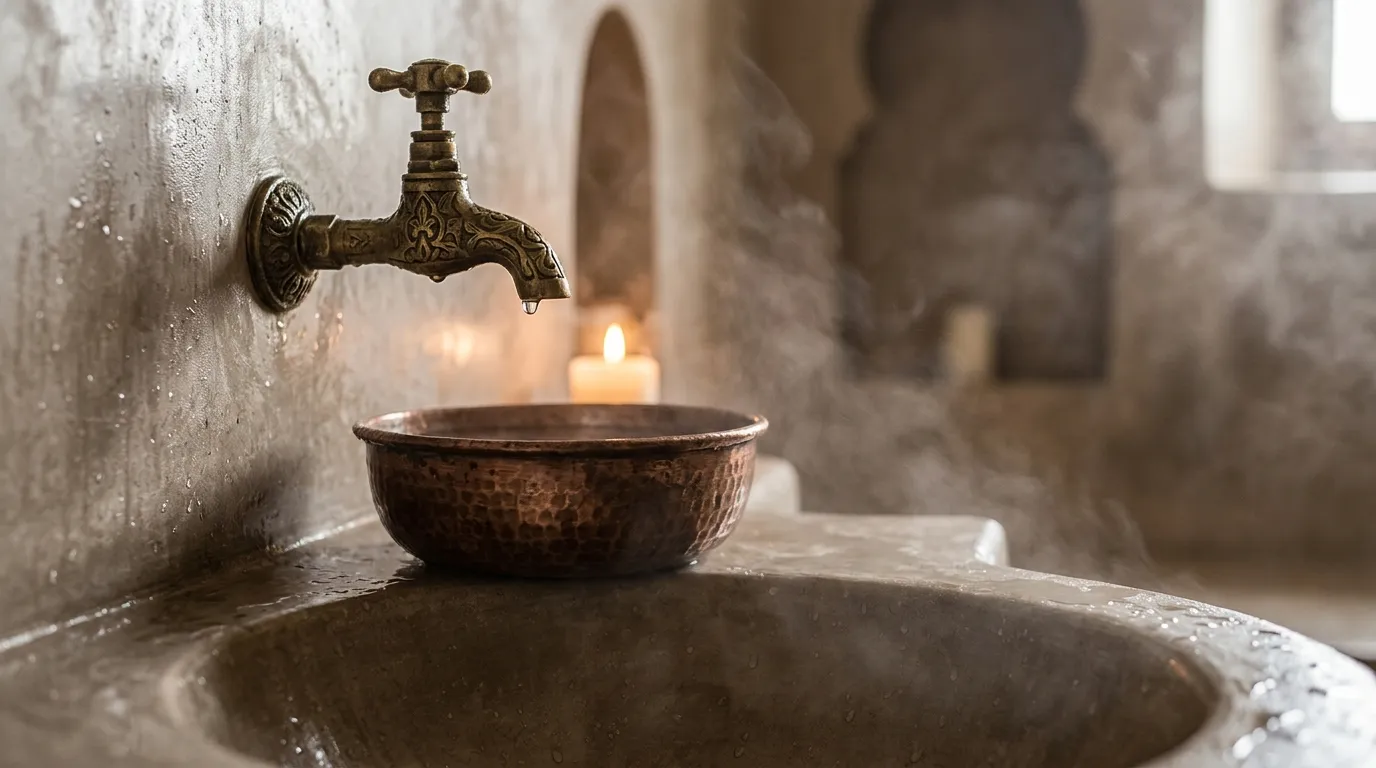
- Moroccan Moorish HammamWarm, humid rooms, water buckets and tadelakt plaster may be found in some hammams; designs and conditions vary by venue.
The Three Thermal Chambers (Al-Buyut)
An authentic Moorish bath moves through a strict temperature gradient designed to soften surface lipids, dilate pores, and prevent cardiovascular shock.
Beit al-Barid
The Cool Room & Rest LoungeThe transition threshold. Here you check in, undress, store valuables, and wrap in a dry cotton fouta. After your treatment, return here to recline on carpeted banquettes, rehydrate, and sip warm fresh mint tea.
Beit al-Wastani
The Warm Working ChamberThe intermediate treatment zone. Attendants coat your skin in viscous savon noir beldi (olive oil paste) to dissolve sebum. It also serves as the rinsing and Atlas Mountain ghassoul clay purification area.
Beit al-Harara
The Hot Steam ChamberPositioned directly above the hypocaust furnace. Heated stone slabs and dense steam open pores within 15–20 minutes, prepping the stratum corneum for the vigorous mechanical kessa exfoliation.
Public Neighborhood Baths vs. Private Riad Spas: Choosing Your Experience
Deciding between a neighborhood public bathhouse (hammam chaabi) and a boutique riad spa (hammam de charme) is not just a question of budget—it defines your entire experience. One is an unvarnished cultural immersion; the other is a serene, turnkey wellness retreat.
The Traditional Bathhouse (Hammam Chaabi)
An essential community anchor serving medina residents. Expect raw energy, thick steam, bucket washing on warm tile floors, and authentic communal customs.
- Setting: Tiled communal steam halls, bench seating, bucket washing on heated floors.
- Atmosphere: Energetic, echoing, family-centered; zero spa music or ambient diffusers.
- Language: Moroccan Darija and functional French only; virtually no English spoken.
- Scrub Intensity: Thorough and athletic; attendants exfoliate with firm, unhesitating pressure.
- What You Bring: Complete DIY kit (soap, glove, bucket, towels, sandals, fresh underwear).
The Boutique Riad Spa (Hammam de Charme)
A tranquil wellness escape set in a restored medina riad. Tailored for privacy, gentle physical rejuvenation, and complete turnkey convenience.
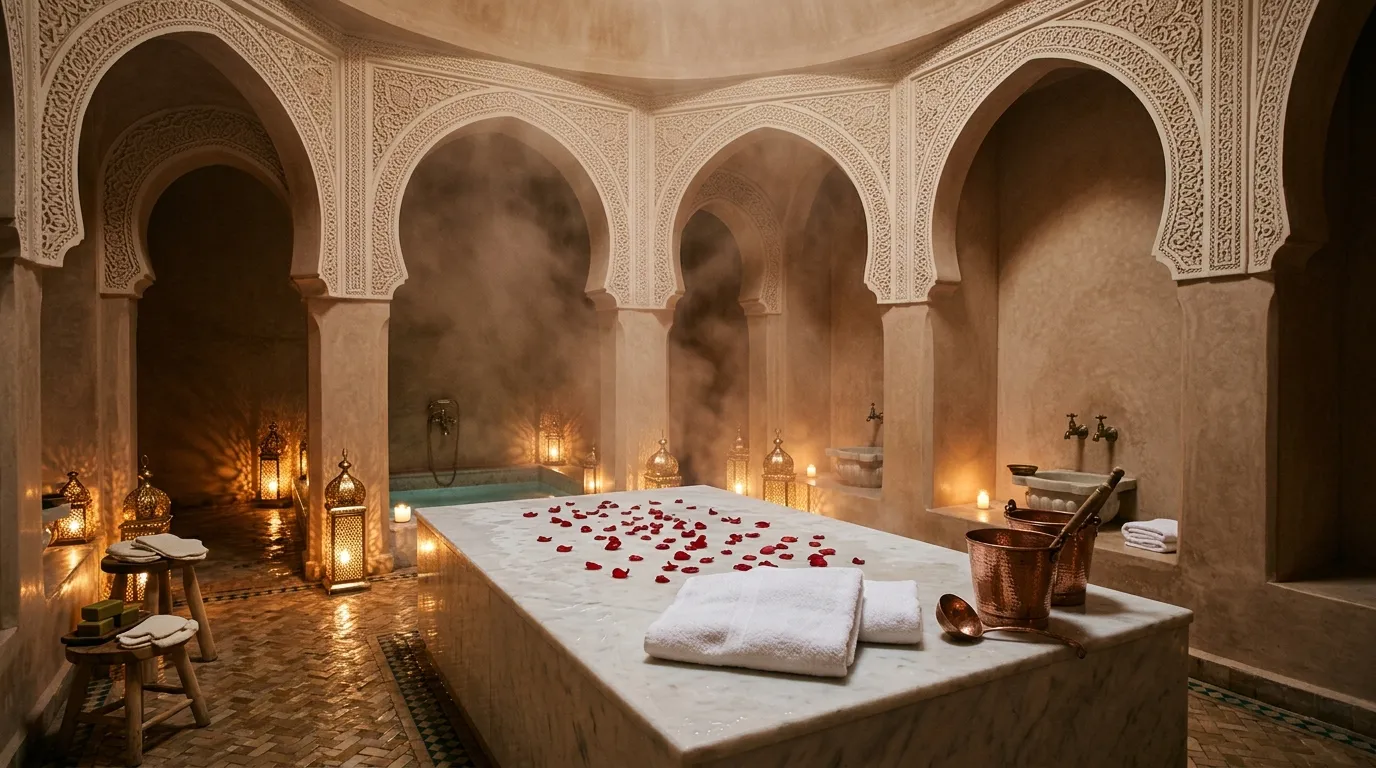
- Setting: Private or dual marble suites, ambient candlelight, eucalyptus aromatics.
- Atmosphere: Quiet, peaceful, and restorative; dedicated rest lounges with fresh mint tea.
- Language: English- and French-speaking receptionists and professional spa hosts.
- Scrub Intensity: Fully customizable pressure from gentle polishing to deep exfoliation.
- What You Bring: Nothing; plush robes, towels, disposable briefs, and organic oils provided.
Side-by-Side Comparison: Public vs. Private Hammam
Scroll horizontally →| Feature | Public Bath (Hammam Chaabi) | Boutique Riad Spa (Hammam de Charme) |
|---|---|---|
| Indicative Price Range | 15–30 MAD entry + 50–100 MAD attendant tip | 400–800 MAD (standard) / 900–1,800+ MAD (luxury + massage) |
| Couples & Mixed Genders | Often separated by gender; confirm venue arrangements | Permitted (private dual suites available upon reservation) |
| Privacy Level | Completely communal steam halls | Private or semi-private rooms may be available; confirm with venue |
| Staff Languages | Moroccan Darija (Arabic), functional French | English, French, Spanish, Arabic |
| Amenities Supplied | Hot and cold running water taps only | Plush robes, towels, slippers, disposable briefs, organic oils |
| Preparation Required | Check what the venue provides; commonly useful items include soap, a kessa glove, towel and sandals | None; fully turnkey experience |
| Exfoliation Intensity | Very firm, thorough, unhurried mechanical scrub | Gentle to medium; modulated upon your request |
| Advance Booking | Not possible; walk in during relevant gender hours | Recommended 24–72 hours in advance (especially peak season) |
Unsure Which Option Fits Your Medina Itinerary?
Navigating gender schedules for public baths or finding private riad spas whose facilities you can confirm directly can be challenging. Connect directly with our Casablanca desk for personalized guidance.
The 2-Hour Authentic Cleansing Ritual (Step-by-Step)
The authentic Moroccan hammam is not an unstructured soak. It is a systematic physiological reset governed by thermal pacing, botanical softening, and athletic mechanical exfoliation to extract impurities and restore the skin’s lipid barrier.
Deep Steam & Acclimatization
Beit al-Harara (Hot Chamber)Recline on warm tadelakt benches. Ambient steam dilates pores, relaxes tight muscle tissue, and hydrates the dead stratum corneum cells. Splash warm water from buckets and begin sweating. Do not apply soap yet.
Savon Noir & Skin Softening
Beit al-Wastani (Warm Chamber)Massage eucalyptus-infused savon noir beldi across wet skin. This potassium-rich olive paste dissolves sebum and loosens dead cell bonds without lathering. Let it penetrate for 5 to 10 minutes.
The Vigorous Kessa Scrub
Beit al-Wastani (Warm Chamber)Your attendant uses a coarse crepe mitt (gant de kessa) in firm strokes. Visible gray rolls of dead skin and trapped oil (crass) peel off painlessly, followed by a warm bucket rinse.
Ghassoul Clay Purification
Beit al-Wastani (Warm Chamber)Apply a smooth mask of volcanic Atlas Mountain ghassoul clay mixed with orange blossom water over your torso, limbs, and hair. The clay draws out remaining toxins and replenishes silica and magnesium.
Cool Rinse, Argan & Rest
Beit al-Barid (Cool Rest Lounge)A cool bucket drench closes pores and stabilizes blood pressure. Wrap in a dry fouta, smooth pure cosmetic argan oil over damp skin to restore lipids, and rehydrate with fresh hot mint tea.
Rinse 100% of Soap Before the Scrub
Unlike commercial shower gels, savon noir is an alkaline keratolytic agent designed to soften dead skin, not provide lubrication.
You must rinse every trace of soap off your body with clean water. If any oily film remains on your skin, the kessa glove will slip harmlessly across the surface rather than catching traction and rolling off dead tissue.
Essential Moroccan Darija Phrases

Modesty, Nudity & Social Etiquette: The Unwritten Rules
Entering a Moroccan bathhouse can feel unfamiliar for first-timers, but the customs inside are welcoming and communal once you understand the boundaries. Modesty (h’shouma), water conservation, and respect for personal privacy govern every visit.
What to Wear (The Two-Pair Rule)
Pack dark, opaque undergarments. Women bathe topless in female communal halls, but dark cotton or bikini bottoms stay on. Men wear dark swim trunks or boxer briefs.
Gender Shifts & Couples
Many public hammams separate visitors by gender, with arrangements varying by venue. Ask the establishment about its current schedule before visiting:
- Women’s Daytime: 10:00 AM to 6:00 PM.
- Men’s Hours: 6:00 AM–9:30 AM & 6:30 PM–11:30 PM.
Water Ethics & Bucket Etiquette
Water is sacred in Morocco. Letting wall taps run continuously into floor drains is considered wasteful and disrespectful.
- Fill two buckets (hot and cold), then shut the tap off completely.
- Carry buckets to your washing space to mix water with a small bowl.
- Sit on a personal plastic mat (hassira) or your towel, never directly on bare tiles.
Attendant Care & Direct Tipping
Attendants (kassal / tiyaba) work with firm, athletic efficiency. Allow your limbs to go completely limp; do not resist their positioning.
Things You Should Do
- Wear rubber slide sandals: Communal floors are wet, soapy, and slippery; wear clean slides at all times.
- Bring your complete DIY kit: Pack black soap, kessa mitt, ghassoul clay, towels, and fresh underwear to public baths.
- Greet your neighbors: A polite nod or “Salam Alaykum” establishes mutual respect with local bathers.
- Speak up during the scrub: Use “Bshwiya” (gently) if the attendant scrubs too aggressively.
Things to Strictly Avoid
- Never take off your underwear: Complete exposure causes immediate cultural offense and ejection.
- Never take photos or videos: Cameras and phones are strictly prohibited inside all bathhouse chambers.
- Never leave water taps running: Fill your wash buckets and turn the faucet off tightly.
- Never hand wet cash inside the steam room: Tip your attendant with dry banknotes in the changing lounge.

Practical Logistics: Packing Checklist & Price Guide
While private riad spas provide a turnkey experience with robes, towels, and organic cosmetics included, visiting a neighborhood public bath (hammam chaabi) requires complete self-reliance. Arriving prepared ensures a hygienic, seamless visit.
Public Hammam Packing List: Your Essential Day Kit
Complete Kit: <50 MAD (~$5 USD) in Medina Souks- Rubber Slide Sandals or Flip-Flops Mandatory
Communal tiles are wet, soapy, and slippery. Walking barefoot is considered unhygienic and carries an immediate slip hazard.
- Gant de Kessa (Exfoliating Mitt) 10–15 MAD
Coarse crepe demerara glove. Buy the standard black version from a souk stall; avoid synthetic tourist shop replicas.
- Savon Noir Beldi (Olive Oil Soap) 10–15 MAD / 100g
Thick olive paste saponified with potassium hydroxide. Choose eucalyptus-infused soap for sinus relief in the hot room.
- Ghassoul Clay (Purifying Mud) 10–20 MAD / packet
Dried Atlas Mountain clay flakes. Hydrate with warm water and orange blossom water to create a clarifying mineral body wrap.
- Two Dry Foutas or Microfiber Towels Essential
One towel to wrap your waist between chambers; a second, bone-dry towel kept inside your locker for dressing.
- Two Pairs of Dark Underwear Essential
One pair worn wet during scrubbing; one fresh, dry pair to put on in the locker room before leaving.
- Waterproof Wet-Bag & Water Dipper 5–10 MAD
A plastic grocery pouch for soaked clothing, plus a small handheld plastic bowl for scooping wash water from your bucket.

Cash & Change Protocol
Public hammams do not accept credit or debit cards. Always carry small Moroccan Dirham banknotes (20, 50, and 100 MAD bills) and 5/10 MAD coins.
Prices below are indicative planning ranges, not live quotes. They may vary by city, venue, season, package and optional services; confirm inclusions and current prices directly before booking.
Hammam Cost Comparison (Indicative)
Scroll horizontally on mobile screens →| Expense Item | Neighborhood Bath (Hammam Chaabi) | Boutique Riad Spa (Hammam de Charme) | 5-Star Luxury Palace (Resort Spa) |
|---|---|---|---|
| Admission / Room Access | 15–30 MAD | Included in package | Included in package |
| Attendant Scrub Service | 50–70 MAD (Direct cash to attendant) | Included in baseline package | Included in bespoke suite ritual |
| Supplies (Soap, Glove, Clay) | 30–50 MAD (Purchased in souk) | Included (Curated botanicals) | Included (High-end organic lines) |
| Full-Body Argan Massage (60 min) | Not available | 300–500 MAD (Optional add-on) | 700–1,500+ MAD (Optional add-on) |
| Typical Attendant Gratuity | 20–30 MAD extra for good service | 50–100 MAD discretionary | 100–200 MAD discretionary |
| Indicative Budget | 115–180 MAD Indicative; confirm locally | Ask for a package quote Optional massage and gratuity may cost extra | Ask for a package quote Optional massage and gratuity may cost extra |
Skin Health, Sensitivities & Medical Considerations
Heat, steam and exfoliation can feel intense, and comfort varies by person and venue. Ask about the temperature and services before starting, choose gentle options if needed, and stop if you feel unwell.
Sunburn & Active UV Damage
Heat, soap and friction may aggravate sunburned, peeling or irritated skin. Consider postponing the visit or avoiding the affected area and exfoliation until it has healed.
Cardiovascular Health & Syncope
Heat and steam may cause discomfort or affect people differently. If you have a heart, blood-pressure, breathing or other health condition, ask a healthcare professional whether heat exposure is appropriate for you; there is no universal safe time limit for everyone. Leave the hot room if you feel unwell.
Eczema, Psoriasis & Facial Care
Friction can trigger severe flare-ups in active eczema, psoriasis, or rosacea patches. Direct your attendant to bypass inflamed skin entirely using the phrase “Bshwiya” (gently).
Electrolyte & Fluid Depletion
Heat exposure can make some visitors feel light-headed. Take breaks, drink according to your needs, and leave the hot room if you feel unwell. Conditions and session lengths vary by venue.
What to Do If You Feel Dizzy Inside the Steam Chamber
If you feel dizzy or unwell, stop the session, tell staff and move to a cooler, safe area if you can do so without risk. Ask staff for assistance. Seek urgent medical help for severe or persistent symptoms.
- Pause and get help: Sit or lie down somewhere safe and cooler if possible; avoid walking alone if you feel faint. Ask staff or a companion to assist you.
- Signal for Help: Call out the Darija word “Dukha” (دوخة — dizzy) or French “Vertige”. Tell a staff member or companion that you feel dizzy and ask for help.
- Stay comfortable: Follow staff guidance and move away from heat if safe. Do not continue the session while you feel unwell.
- Get assistance: Ask staff to help you reach a cooler area. For severe or persistent symptoms, seek urgent medical help.
Aftercare and Skin Comfort
After a scrub, skin may feel dry or sensitive. Use products that suit your skin and stop using anything that irritates it:
- Moisturize if needed: Choose a familiar, fragrance-free moisturizer if your skin feels dry or sensitive.
- Avoid irritating products: If skin feels sensitive, pause products that sting or cause irritation and follow advice from your clinician.
- Sun protection: Use shade, protective clothing and sunscreen according to its label and your usual routine.
- Choose gentle products: Avoid any product that causes burning, itching or discomfort.
Frequently Asked Questions About Moroccan Hammams
Entering a centuries-old bathing culture naturally raises questions about personal boundaries, physical comfort, hygiene, and social customs. Below are direct, candid answers to the most common questions travelers ask before their first visit.
Is the kessa exfoliating scrub painful?
No, when performed correctly, the scrub is invigorating rather than painful. You will feel firm friction as the coarse crepe mitt catches dead epidermal cells, causing gray coils of dead skin (crass) to roll off. It can feel abrasive across sensitive areas like collarbones or inner thighs. If the attendant scrubs too aggressively, immediately say “Bshwiya” (gently) to modulate pressure.
Can unmarried or LGBTQ+ couples book private sessions?
Public hammams commonly organize access by gender, but policies differ by venue. Some private spas offer couples sessions; ask the establishment directly about availability, privacy, documentation and its visitor policy before booking.
Can I visit a hammam during menstruation?
Policies and personal preferences differ. Ask the venue about its facilities and rules if needed, and choose what feels comfortable for you. If you have a health concern about heat or menstruation, consult a healthcare professional.
How clean and sanitary are public neighborhood hammams?
Neighborhood hammams are thoroughly washed down daily with hot water and bleach by the overnight furnace staff. Because bathers wash using fresh bucket drenching rather than soaking in standing communal pools, the risk of waterborne cross-contamination is minimal. For personal comfort, bring your own plastic sitting mat, wear rubber slides at all times, and purchase a brand-new kessa glove in the souk.
Are visible tattoos acceptable inside a Moroccan bathhouse?
Yes. While tattoos were historically associated with indigenous Amazigh (Berber) tribal markings rather than modern body art, foreign travelers with tattoos encounter no hostility. In neighborhood baths, you may attract curious glances from older bathers or children, but tattoos do not violate bathhouse rules. Observing modesty protocols and wearing dark swim bottoms matters far more than having ink.
What if I don’t speak Moroccan Arabic (Darija) or French?
In private boutique spas, hosts speak conversational English and French. In neighborhood public baths, attendants rarely speak English, but the scrub sequence is almost entirely physical. Attendants use gentle shoulder taps, arm gestures, and head nods to guide you. Memorizing just two words—“Bshwiya” (gently) and “Shukran” (thank you)—is all you need for a smooth visit.
Looking for Vetted Hammams in Specific Cities?
Bathhouse practices vary by venue and region, Policies, facilities and services vary by city and venue. Check current information and ask questions before booking.
Join the Morocco Wayfinder Community & Travel Concierge
Planning an authentic bathhouse visit shouldn’t involve guesswork. Whether you need an unvarnished review of a neighborhood hammam in Fes or want to reserve a vetted, couple-friendly private riad spa in Marrakech, our community and Casablanca team are here to help.
The Morocco Wayfinder Travel Community
Connect with independent travelers, expats, and Moroccan locals. Ask real-time questions about bathhouse cleanliness, check gender hours, and share post-scrub travel experiences.
- Unfiltered Reviews: Real traveler reports on historic neighborhood baths across Marrakech, Fes, and Casablanca.
- Cultural Etiquette: Practical advice from solo female travelers and couples navigating traditional spaces.
- Medina Logistics: Peer tips on navigating souk alleys and finding clean, respectful bathhouses.
Direct WhatsApp Travel Concierge
Traveling as an unmarried couple, visiting with sensitive skin, or seeking a tranquil private riad spa with verified hygiene? Chat directly with our Casablanca travel desk for personalized guidance.
- Vetted Riad Spas: Handpicked private hammams with pristine cleanliness and transparent pricing.
- Couples Booking: Guidance securing private dual suites without awkward booking hurdles.
- Schedule Verification: Quick confirmation of changing public bathhouse hours and seasonal shifts.
Researched on the Ground from Casablanca
Morocco Wayfinder is an independent travel intelligence platform operated directly from our operational desk in Casablanca. We never accept sponsored bathhouse treatments, paid reviews, or undisclosed commissions that compromise our editorial integrity. Every tariff, protocol, and etiquette standard in this guide is verified against active 2026 municipal rates and on-the-ground field practices. Learn more about our editorial team and research methodology on our About Us page.